
Why LettUs Grow are pioneering UK glasshouse rubber production
At LettUs Grow, while we are well-known for our work with leafy greens and herbs, our technology is a powerful tool for solving some of the world’s most complex supply chain challenges. We are thrilled to announce our participation in the QuBOOSTR Consortium - a £2.4 million precision breeding project designed to domesticate the humble dandelion as a sustainable, UK-based source of natural rubber.
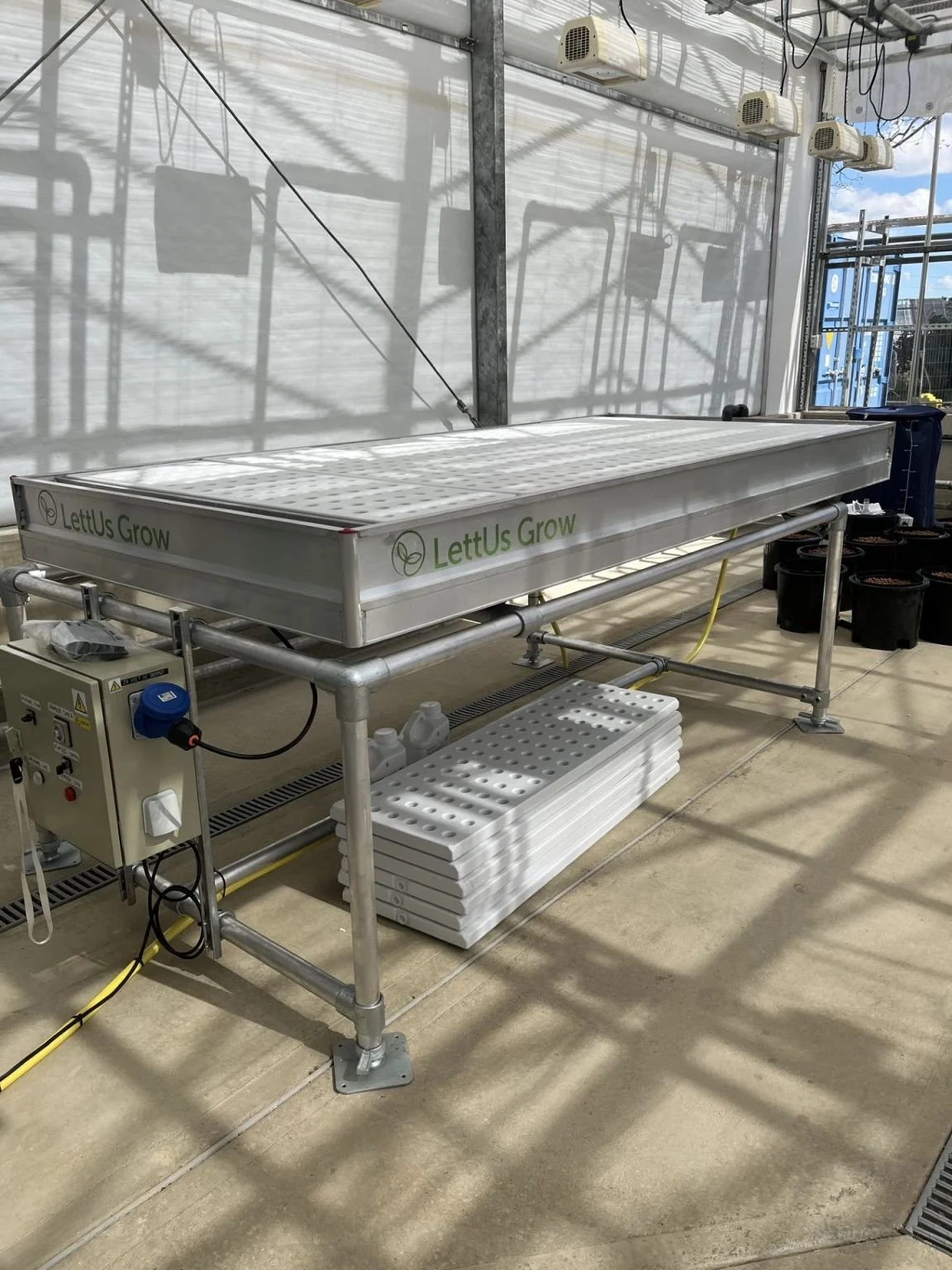
LettUs Grow’s first Aeroponic Rolling Bench installed at John Innes Centre’s glasshouse.
The global rubber crisis. Why Dandelions?
Dandelions, the persistent yellow flowers in your lawn, hold a secret. Their root systems naturally produce latex. Currently, the world relies almost entirely on the Hevea brasiliensis (the rubber tree), which is primarily grown in Southeast Asia. This global supply is increasingly under threat from climate change, disease, and geopolitical supply chain vulnerabilities.
For years, the hurdle was that dandelion latex levels were simply too low to be commercially viable for manufacturing. However, the QuBOOSTR (Quality Bioengineering for Optimised Output & Sustainable Technologies in Rubber producing crops) project is set to change that. By leveraging gene editing and advanced analytical tools, we are working to optimise these plants for high-grade production at a scale that can actually meet industrial demand.
The Collaboration
Innovation of this scale requires a diverse team of experts. We are proud to be working alongside lead partner QuberTech and the world-leading plant scientists at the John Innes Centre. This initiative is supported by the UK Government Defra’s Farming Innovation Programme and delivered in partnership with Innovate UK.
By combining the John Innes Centre’s world-leading plant science with QuberTech’s gene-editing expertise and LettUs Grow’s Advanced Aeroponics™ technology, the partnership will optimise the crop for high-density, soil-less indoor farming.
The role of Advanced Aeroponics™
In a project focused on harvesting latex from roots, the growing environment is everything. This is where our Aeroponic Rolling Bench™ technology (ARB) comes into play. Unlike traditional soil-based farming or even hydroponics, aeroponics allows us to grow plants with their roots suspended in a nutrient-enriched mist.
Why aeroponics is the ultimate enabler for rubber production:
Enhanced root development, by providing a precise, soil-free environment, we can maximise the growth and health of the roots where the latex is produced.
Clean and easy access as there is no soil or substrate to wash away, we have direct, clean access to the roots. This is vital for scientists who need to study the latex and for growers who need to harvest it efficiently.
Optimised performance as we can tailor the environment, adjusting everything from mist frequency to nutrient balance, to boost the crop’s performance and latex output.
High-density scaling as our ARB technology is designed for commercial glasshouse and indoor farm environments, allowing for a massive increase in plants per square meter.
Unlocking new markets for commercial growers
For us at LettUs Grow, QuBOOSTR represents a significant expansion into crops that can unlock new markets. We believe that by proving the efficacy of aeroponics for industrial materials, we are opening new doors for commercial growers to diversify their businesses.
As our Co-Founder and CSO, Jack Farmer, puts it: "By boosting crop performance and enabling clean and easy access to the crop roots, we believe this exciting R&D could further expand the market for high-tech glasshouse operators worldwide."
Imagine a future where a UK glasshouse manager isn't just deciding between tomatoes or cucumbers, but has the option to grow high-value industrial commodities like rubber. This transition helps break down the barriers currently holding farmers back, allowing them to participate in new, high-margin markets.
Building national resilience
Beyond the commercial potential, there is a clear strategic benefit. The QuBOOSTR project enables the UK to innovate new crops and secure a sustainable, domestic supply of rubber. By reducing our reliance on long, vulnerable international supply chains, we are helping to build a more resilient national economy. We are incredibly excited for this work and play our part in boosting the resilience of the global rubber supply. It’s a perfect example of how high-tech biotech and smart farming can come together to solve supply-chain problems.
If you’d like to speak to the team about this project or have any questions, please reach out to info@lettusgrow.com
